





Music IBCP
The Music CP offers three specialised areas — Performance, Composition, and Sonic Arts, each designed to develop students’ unique musical voices and skills, and prepare them for conservatory training and professional careers.
Students will select one Specialised Area and fulfil the requirements of three Career-related Studies (CRS) within that area. Students may opt to take a fourth CRS module (as an elective) from the other two Specialised Areas.
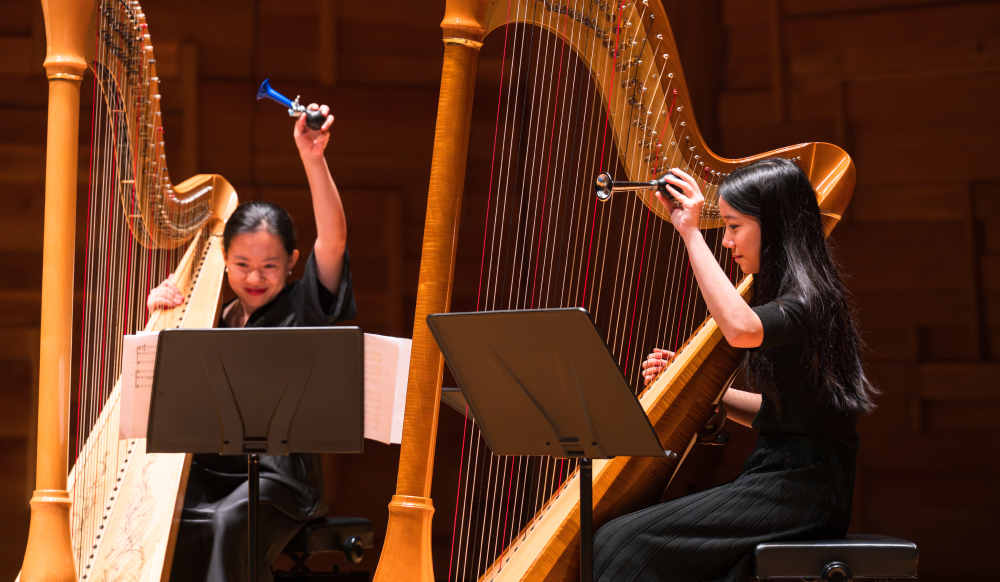
| Specialised Areas | ||
|---|---|---|
Performance
|
Composition
|
Sonic Arts
|
Practical Musicianship
Treading across all three Specialised Areas, the Practical Musicianship module will enhance students’ understanding and proficiency in applying musicality into practice. It focuses on developing students in areas such as aural skills to develop critical listening abilities; score analysis to understand musical structure, harmony, and compositional techniques; and conducting where they lead ensembles and interpret musical works.
Collaborative Music-making
A CRS module under the Performance Specialised Area, the Collaborative Music-making module focuses on developing students in areas such as musicianship, where students refine technical and interpretive skills within ensemble contexts; rehearsal and ensemble skills as they learn to collaborate effectively and communicate with other musicians to develop non-verbal and musical dialogue across different musical genres.
Performance and Repertoire Studies
A CRS module under the Performance Specialised Area, this module focuses on developing critical listening skills to discern and interpret the quality of performances and encourage students to explore a diverse repertoire of works across periods and styles to gain a greater awareness of historical context and the evolution of music and musical performances.
Compositional Approaches
A CRS module under the Composition Specialised Area, Compositional Approaches will develop students to be competent in compositional techniques as they master the craft of musical creation through various methods, and encourage experimentation as they push boundaries to explore compositional approaches across diverse musical traditions and cultures.
Analysis and Interpretation
A CRS module under the Composition Specialised Area, Analysis and Interpretation will focus on the application of theory into practice (listening, performing, composing) and research in the first year of study. When students progress to the second year, they will gain experience through rehearsals and hone their interpretive skills, which are required for performing new compositions.
Audio Production
A CRS module under the Sonic Arts Specialised Area, the Audio Production module aims to equip students with the fundamentals of producing digital music recordings such as planning, executing and completing small-scale recording projects. Through this module, students will learn about live sound reinforcement and understand the roles and responsibilities of a live sound engineer and production management.
Sound Design
A CRS module under the Sonic Arts Specialised Area, Sound Design will develop students with the fundamental knowledge and skills in audio editing, sound sampling, and post-production. Students will explore how sound elements can add depth, emotion, and meaning to narratives and art installations, and achieve software proficiency as they work across diverse platforms to expand their creative tools and techniques. Through this module, students will be able to communicate their artistic vision and translate creative concepts into tangible soundscapes through technical mastery and innovative application.
Alumni Stories
“Being the first cohort of IBCP graduates, my friends and I took the leap of faith to embark on the programme. It was immensely exciting but it was also a time where we had a lot of big and small questions about our future. SOTA’s IBCP provided a sense of grounding and certainty, whilst holding the space and chance for my friends and I to live these questions and enjoy the uncertainty that comes with embracing and sitting with these questions.”
Lin Xiangning (Music CP, Class of 2015)
Master of Music (Piano Performance), Yong Siew Toh Conservatory of Music (NUS) and PhD candidate (History), NUS